Rabindranath Tagore, Bird Fantastic, c. 1930. National Gallery of Modern Art, New Delhi. Wikimedia Commons, public domain. Reproduced for commentary and analysis.
The painting is small. A skeleton holds a lantern. A crow sits above still dark water. The colors range from bone white to midnight blue and a dark ochre that seems to absorb light. These paintings were created by Ganesh Pyne using tempera on small panels over several layers over many months. It does not resemble a painting from European Surrealism, but it does not aim to do so either. The characters were taken from Bengali fairy tales, inspired by the memory of a boy who had listened to the stories narrated by his grandmother by the light of a lamp in a decaying building in North Kolkata. The visual grammar is Indian, specific, and built over a lifetime.
That specificity is the first thing to understand about Indian Surrealism. It was never a formal movement with a manifesto or founding exhibition. What it was — and what it remains — is a way of making images that hold the real and the impossible in the same frame, drawn from local tradition rather than European psychoanalysis.
Tagore in Paris, 1930: A Parallel Modernism
André Breton published his Manifeste du surréalisme in Paris in 1924. Six years later, Rabindranath Tagore exhibited a body of drawings at the Galerie Pigalle in May 1930 — the same venue that, months afterward, would host a major Surrealist exposition. European critics saw in Tagore's fluid ink washes something close to their own emerging language. They were looking at something built from different foundations entirely.
Tagore had begun doodling inside the crossed-out lines of his poetry manuscripts around 1924. Fantastical animals emerged from erasures; birdlike forms grew from geometric ink marks. The surface resembled automatism — the Surrealist technique of drawing without conscious control — but the intent was different. Where Breton's circle sought to access the irrational, Tagore was searching inward for spirit, not disorder. Scholar Rakhee Balaram has described this as "pirate Surrealism": a parallel modernism sailing beside Breton's, but navigating by a different compass, pointed toward introspection and what she calls the "colonial unconscious" — the psychic weight of empire on the imagination.
Bird Fantastic makes that visual logic plain. The bird is elongated, dark, claws tense, constructed from fluid lines rather than naturalistic observation. It sits somewhere between calligraphy and mythology — assembled from the same mark-making as the manuscript doodles that preceded it. Color is minimal; the line does everything. Tagore's 1930 exhibition showed around 400 works and then traveled to Berlin, Munich, Moscow, and beyond. It was the first significant relay between Indian and European experiments with the impossible image — but not the origin of that tradition in India. Composite animals in Mughal court drawings, Tantric geometric diagrams, the hybrid beings of Bengali Kalighat scrolls: Indian visual culture had been making impossible images for centuries before Breton named them.

Rabindranath Tagore, Brooding, c. 1930s. Wikimedia Commons, public domain. Reproduced for commentary and analysis.
Brooding shows the other side of Tagore's visual register. The face emerges from dense ink wash, almost submerged in the dark ground, features dissolved into atmosphere rather than defined by line. There is no clean contour, no academic modeling. The image looks built by erasure and accumulation rather than by deliberate drawing — which is precisely what it was. These two paintings together, Bird Fantastic and Brooding, map the range of Tagore's approach: one constructive and geometric, the other dissolving and atmospheric, both working at the edge of legibility.
Three Post-Independence Painters, Three Visual Systems
What shifted after 1947 was urgency. A partitioned subcontinent, Naxalite political violence in Bengal through the 1970s, the unsteady identity of a newly independent nation — these pressures fed directly into how Indian painters of the mid-twentieth century handled the language of the unreal.
Bikash Bhattacharjee (1940–2006) embedded his distortions inside a surface of near-photographic realism. He worked in oil on canvas with the precision of a technically trained figurative painter — his acknowledged influences included Francis Bacon, René Magritte, and Andrew Wyeth — then placed inside that surface something wrong. In the Doll series, conceived in 1971, the protagonist is a lifelike doll: eyes erased, body plastic-smooth, moving through the ordinary environments of a Bengali household. The setting is painted with complete accuracy — drawers, clotheslines, the specific texture of a Kolkata rooftop. The doll creeping across that surface is the only impossible element, and its calm makes it more unsettling than any montage effect would.

Bikash Bhattacharjee, Doll, 1972–73, oil on canvas. National Gallery of Modern Art, New Delhi. Google Arts & Culture / NGMA. Reproduced for commentary and analysis.
The painting called Doll (1972-1973), in the collection of the National Gallery of Modern Art, New Delhi, provides the best example of this approach. The doll moves gently into the partly open drawer, where each surface appears photorealistically, within a domestic interior that is very realistic. Nothing in the paint surface announces the uncanny. The painting reads as a careful observation until it doesn't, and that delay is where the meaning lives. Bhattacharjee's later Durga series applied the same pressure to religious iconography, placing the goddess into the body and circumstances of ordinary Bengali women — the divine made specific and local rather than removed and symbolic.
Ganesh Pyne (1937–2013) worked at the opposite end of the scale, both physically and atmospherically. The panels painted in tempera are small, compact and formed slowly and gradually. Using watercolor and gouache in the beginning, he found a niche in tempera because of its transparency: colors applied in very thin layers and dried before painting the next one, creating luminescence that seemed to shine from within the painted surface. Colors chosen – dark ochre, phosphorus blue, white of bones against black – were appropriate for the imagery taken from Bengali folk stories and personal childhood experience of death during the riots in Calcutta in 1946. Skeletons, puppet masters, crows, boats made of ribs: these recur across his work not as imported symbols but as images rooted in specific memory and specific story.

Ganesh Pyne, artist profile and collection documentation page. DAG, New Delhi. For individual work images, contact DAG directly at dagworld.com. Reproduced for commentary and analysis.
Pyne called his practice "poetic surrealism," deliberately separating it from the European version. His work does not argue with reason; it does not shock. The small scale demands that the viewer lean forward, placing them close enough to see individual brushstrokes — the texture of a painted crow's wing, the glow built into a circle of night-blue sky. The imagery then arrives quietly, the way a half-remembered story does.
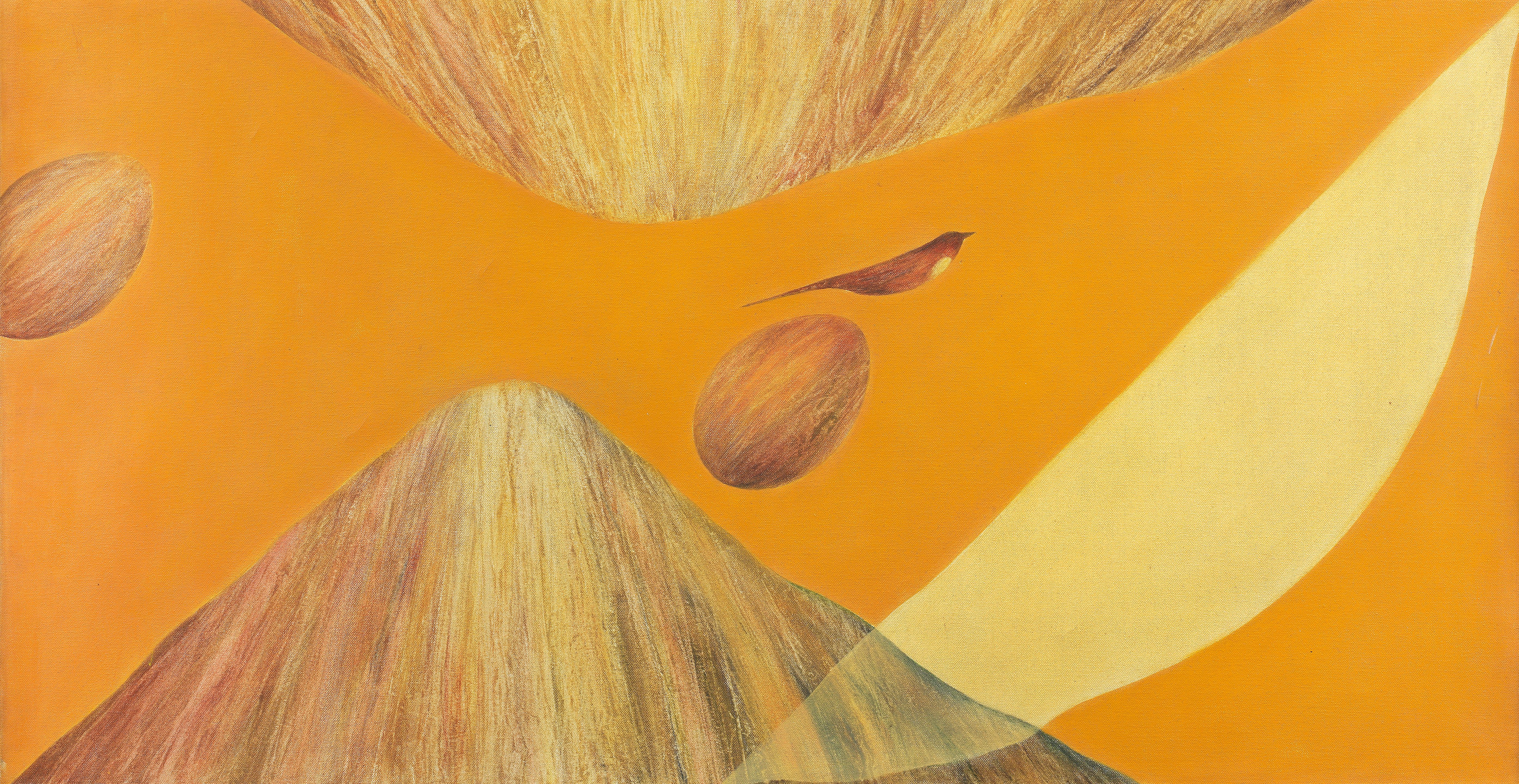
Jagdish Swaminathan (1928–1994) worked in a different register entirely. His compositions use flat planes of saturated color drawn partly from the Pahari hill painting tradition — blocks of unmixed pigment, minimal shading — and partly from his years at the Academy of Fine Arts in Warsaw. Where Bhattacharjee embedded distortions in photographic surface and Pyne built atmospheric darkness, Swaminathan reduced his compositions to color field and a single figurative element. His Bird and Mountain series, made through the 1960s to 1980s, places a small bird against geometric color planes representing landscape. The bird is always small and specific in its placement; the scale relationship between the lone figure and the vast color field is the subject of the painting.

Jagdish Swaminathan, Untitled (Mountain and Bird Series), oil on canvas, c. 1980s. Bonhams auction record. Reproduced for commentary and analysis. Note: for the V&A work Red and Yellow with Bird (1972, accession IS.16-1986), no public digital image is available; contact vaimages@vam.ac.uk quoting IS.16-1986.
Swaminathan's stated project was incorporating tribal and folk elements into a modernist pictorial language. The geometric forms in his canvases echo the designs painted on the floors and walls of village homes across central India, a tradition he encountered directly as director of the Roopankar Museum at Bharat Bhavan in Bhopal from 1981 to 1990. A work from 1993 in the National Museum of Asian Art (Smithsonian), accession S1998.117, shows him scoring deeply into wax-mixed pigment with a sharp tool, creating a richly textured central section bearing inscriptions of the Devanagari letter ka — connecting written language, earth tone, and the geometric sun forms drawn at the bottom of the composition.
What Sets Indian Surrealism Apart Visually?
Three visual patterns distinguish this body of work from its European counterpart. First, mythological imagery is subverted rather than abandoned. K.C. Pyne — Ganesh Pyne's uncle — painted a Goddess Durga in pure white, stripped of her traditional color. The image is recognizable and emptied at once, gaining strangeness from removal rather than from addition. Secondly, the function of the vernacular source is practical instead of decorative. Some artists like K.G. Subramanyan and Madhvi Parekh have used the techniques of flat plane treatment and outlining from Kalighat painting and terracotta, which have changed the format of the paintings rather than only the surface effect of the paintings. Thirdly, the emotional tone is more static than shocking. European Surrealism, in its most programmatic form, aimed to disorient. Indian artists working in this territory more often aimed for something closer to the particular suspended attention of a story told at night.
The Contemporary Practitioners
Contemporary artists working inside this lineage have made the medium itself the argument. Ranbir Kaleka projects moving video directly onto painted canvas. In works like House of Opaque Water and his later Guardians in a Dystopic Garden – 2 (2023), two timelines inhabit the same surface — the painted and the filmed — without resolving into each other. The surreal displacement is temporal rather than spatial: what the eye sees and what time it belongs to are two different things.

Ranbir Kaleka, House of Opaque Water, video installation, 3 screen-panels, each 213.4 × 149.6 cm. Volte Gallery / Google Arts & Culture. Reproduced for commentary and analysis.
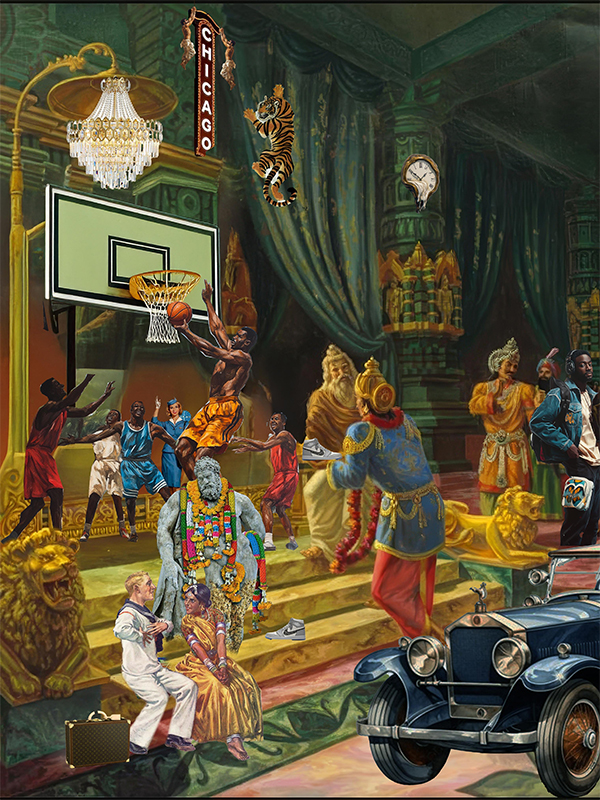
Abhay Sehgal, who studied at the School of the Art Institute of Chicago and returned to India to develop his practice, works through hand-drawn digital sketches scaled up to large canvases. His Chicago Durbar commission — an 11-by-10-foot painting for a Chicago restaurant — maps the visual conventions of a Mughal royal court onto a specific American cityscape the artist knew from daily life. The Chicago Theatre sign appears where a courtly architectural element might stand. Historical Indian visual language and contemporary urban experience occupy the same pictorial space on equal terms, with neither flattened into the other.

Abhay Sehgal, studio and works documentation. Design Pataki, 2025. Reproduced for commentary and analysis.
A Tradition That Preceded the Term
The 2013 exhibition The Surreal in Indian Painting at Prahlad Bubbar Gallery, London, gathered twenty-four paintings from the seventeenth to the nineteenth century — composite elephant drawings from Mughal court workshops, Tantric diagrams from the Punjab Hills, figure paintings from Orissa — and placed them beside the European Surrealist canon. A composite elephant drawing from around 1625, assembled from dozens of interlocked human and animal figures by an imperial court artist, is technically demanding and iconographically coded. It was built deliberately, with great skill. The Surrealist parallel helps a Western viewer locate it in a familiar frame, while also risking a flattening of what the image actually is: a distinctly Indian visual logic in which the impossible and the sacred were never as far apart as European modernism assumed.
The Painting That Stays
Pyne's small tempera panels are held by DAG in New Delhi and by private collectors across India and abroad. They are rarely photographed in a way that captures the quality of their light — a glow that reproduction flattens. Seeing them in print is understanding them at one remove. The actual surface, built from months of layered color applied with careful control, does what the best work in this tradition does: makes the impossible feel remembered rather than invented, specific to a place and a person and a set of stories told by lamplight in a house that no longer stands.